April 01, 2026
Cloud Computing Role in Edge AI: Improving Scalability and Efficiency
Artificial Intelligence has pushed the boundaries of what machines can achieve. As devices get smarter, they also demand faster processing and better data management. The cloud computing role in edge AI is becoming the backbone of this progress, connecting real-time decision-making at the edge with the scalability of cloud infrastructure. In this guide, SmartOSC explains how this collaboration transforms scalability, efficiency, and innovation across industries.
Highlights
- The cloud computing role in edge AI bridges fast, local decision-making with the massive processing and scalability of cloud infrastructure.
- Hybrid AI systems combining edge and cloud computing improve efficiency, energy use, and real-time responsiveness across industries like healthcare, manufacturing, and smart cities.
- Future AI ecosystems will rely on intelligent hybrid architectures, dynamic workload distribution, and 5G-enabled connectivity to support scalable, data-driven automation.
Understanding the Cloud Computing Role in Edge AI
What Is Edge AI?
Edge AI refers to artificial intelligence that processes data locally, on devices or nearby servers, instead of sending everything to a remote cloud. This allows applications to respond instantly, without waiting for data transmission. In McKinsey testing of voice-assistance tasks, pure cloud setups showed 1000 to 2200 milliseconds of latency, while edge deployments came in around 300 to 700 milliseconds. This is the difference between a lag and a real-time response.
It’s the foundation of smart technologies, self-driving cars that react in milliseconds, healthcare monitors that alert doctors in real time, or surveillance systems that recognize patterns without human intervention.
The biggest strengths of Edge AI include:
- Lower latency: Decisions happen where data is created.
- Improved privacy: Sensitive information stays within local networks.
- Reliable performance: Even if the internet connection drops, AI still functions.
These qualities make Edge AI a cornerstone for industries needing precision and speed. At the same time, Gartner expects that by 2025 about 75% of enterprise-generated data will be created and processed outside traditional data centers or the cloud, which is why pushing more intelligence to the edge has become a priority.
What Is Cloud AI and How It Differs from Edge AI?
Cloud AI, in contrast, relies on centralized data centers. It’s where deep learning models are trained, massive datasets are processed, and analytics are refined. This central infrastructure supports computationally heavy workloads that edge devices cannot handle alone. To grasp the scale, enterprises spent about 330 billion dollars on cloud infrastructure services in 2024, with generative AI now a major growth driver.
The distinction lies in where intelligence resides. Edge AI brings intelligence closer to the data source, while Cloud AI scales intelligence across regions. Cloud-based environments allow for massive scalability, storage, and collaboration, powering applications that require high-volume data access or constant updates.
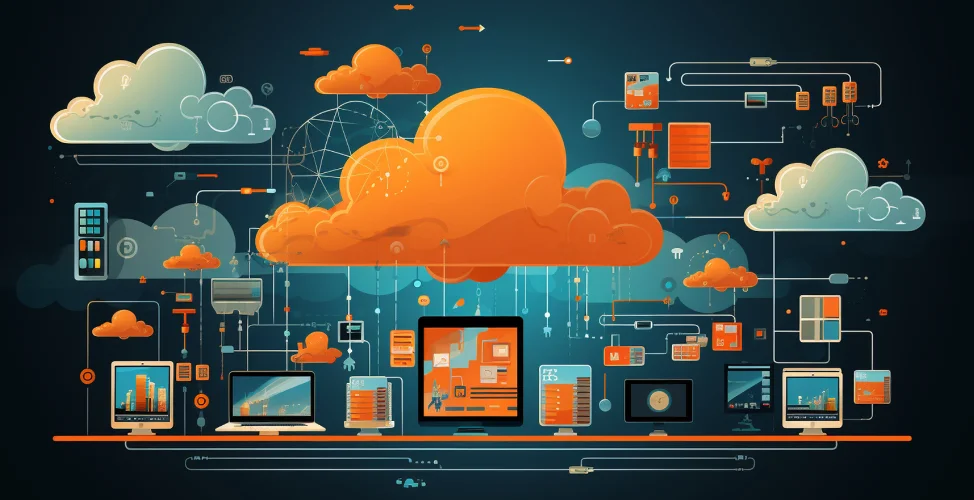
Without the cloud, Edge AI would struggle to evolve. Without the edge, Cloud AI would face latency and connectivity limits. Together, they form a balanced architecture where cloud systems act as the brain and edge devices serve as the hands.
Why Cloud Computing is Important for Edge AI
The cloud computing role in edge AI extends far beyond remote storage. It enables model training, data synchronization, and real-time updates across distributed devices. AI models developed in the cloud can be deployed to thousands of sensors, cameras, or robots simultaneously. With 16.6 billion connected IoT devices at the end of 2023 and a forecast of 18.8 billion by the end of 2024, the scale of those deployments is expanding quickly.
Cloud platforms also maintain centralized analytics, so performance data from edge devices can be reviewed, refined, and used to retrain models. This continuous cycle improves accuracy and efficiency. Organizations are backing this with real budgets, as worldwide spending on edge solutions is estimated at about 261 billion dollars in 2025, reflecting how closely edge and cloud investments now move together.
Scalability, flexibility, and storage capacity make cloud computing indispensable. Through hybrid architectures, businesses gain both the immediacy of edge processing and the analytical power of cloud infrastructure, creating intelligent systems that think fast and learn continuously.
Watch more: How Generative AI Application Development is Transforming Business Operations
How Cloud Computing Enhances Scalability and Efficiency in Edge AI
As AI systems grow more complex, scalability and efficiency become the foundation for their success. The cloud computing role in Edge AI gives these systems the flexibility and processing strength needed to handle this growth without slowing performance.
Scalability Through Centralized Cloud Resources
Scalability is where the cloud truly shines. Cloud platforms like AWS, Azure, and Google Cloud provide nearly unlimited computing resources that can expand or contract depending on workload demands.
Consider industrial IoT networks with thousands of sensors. Edge nodes gather raw data, while the cloud handles aggregation, model training, and long-term analytics. This distributed setup prevents local overloads and guarantees high performance across the system.
Cloud computing enables edge deployments to:
- Access global infrastructure without investing in physical servers.
- Synchronize updates instantly across devices.
- Scale AI models dynamically based on regional demands.
This capability is particularly valuable for smart city initiatives and automated manufacturing plants where new devices are continuously added.
Improving Efficiency with Cloud-Enabled Data Management
Efficiency comes from managing workloads intelligently. Edge devices handle immediate tasks, while the cloud manages large-scale processing and coordination. This division minimizes latency and avoids overwhelming limited hardware, which is why partnering with an experienced AI application development company can help businesses design and optimize these hybrid architectures effectively.
Cloud systems also handle data lifecycle management, collecting, cleaning, and redistributing information for AI improvement. Techniques like caching, distributed databases, and serverless computing optimize data flow between the edge and the cloud.
Containerization tools like Docker and Kubernetes simplify deployment. Developers can package AI applications once and deploy them anywhere, whether on edge devices or across multiple cloud regions. This unified environment helps teams manage updates, balance workloads, and ensure consistent performance.
Hybrid models also improve energy efficiency, an increasingly important factor as AI adoption grows. Instead of processing everything in remote servers, workloads are shared intelligently, cutting both power usage and cost.
Real-World Use Cases
Healthcare
Edge AI allows real-time monitoring of patients through wearable devices, while cloud platforms store and analyze massive datasets. This balance helps detect anomalies instantly and refine long-term diagnostics. Hospitals using hybrid AI systems have seen latency drop to around 30 ms, compared to over 200 ms in cloud-only setups.
Autonomous Vehicles
Cars equipped with AI chips make instant driving decisions at the edge. The cloud, meanwhile, stores data from thousands of vehicles to improve global driving algorithms. This connection helps vehicles learn from shared experiences, weather conditions, road patterns, or potential hazards, similar to how AI personalization eCommerce systems continuously learn from user behavior to deliver more accurate and tailored recommendations over time.
Smart Cities
In large cities, edge sensors monitor traffic lights, pollution, and public safety. The cloud aggregates this information to support predictive analysis, infrastructure planning, and energy management.
Across industries, this combination bridges real-time intelligence with large-scale insight.
Key Challenges and Trade-Offs
Bringing together edge and cloud systems delivers clear advantages, yet it also introduces a new set of challenges. Understanding these trade-offs within the cloud computing role in Edge AI helps businesses decide how to balance performance, cost, and security in real-world AI deployments.
Latency vs. Scalability
The tension between speed and scalability defines the core challenge of hybrid AI systems. Edge computing ensures low latency, which is crucial for time-sensitive decisions like medical alerts or factory automation. Cloud computing provides scalability but introduces delay because data must travel back and forth.
The right balance depends on application needs. High-frequency operations benefit from local inference, while strategic analytics and retraining happen best in the cloud. Together, they create a feedback loop where each part supports the other.
Data Privacy and Security
Data privacy remains a major concern. Edge AI helps protect sensitive information by keeping it local, but edge devices often lack robust encryption or multi-layer defenses.
Cloud providers invest heavily in security infrastructure, including encrypted transmission, identity management, and compliance frameworks. Some organizations adopt federated learning, which allows edge devices to train models independently and share only the model updates, not the raw data.
This approach keeps personal or confidential data secure while still benefiting from the collective intelligence of cloud collaboration.
Cost and Energy Efficiency
Operational costs vary between architectures. Edge systems reduce data transmission costs but require investment in distributed hardware. Cloud environments use subscription models, allowing companies to scale without upfront infrastructure expenses.
Hybrid systems often strike the best balance. They use the cloud for heavy computation while keeping lightweight tasks on the edge, minimizing power use and optimizing budgets.
Sustainability is also shaping architecture choices. Cloud providers are shifting toward carbon-neutral operations, while edge deployments focus on extending device battery life through smarter workload management.
See more: AI and Cloud Technology: How They’re Powering the Future of Digital Transformation
The Future of Hybrid Cloud-Edge AI Systems
The relationship between cloud and edge is moving toward greater harmony. As technology evolves, the cloud computing role in Edge AI continues to shape a future where intelligence, speed, and scalability work together seamlessly.
Emergence of Intelligent Hybrid Architectures
The next generation of AI systems won’t rely solely on one approach. Hybrid architectures are evolving into dynamic ecosystems where workloads move fluidly between edge and cloud based on context and demand.
This flexibility depends on fast connectivity and real-time coordination. With 5G and Cloud integration, data can move almost instantly between nodes and central systems. AI model retraining pipelines allow cloud environments to push updated models back to devices, keeping intelligence current and accurate.
These ‘intelligent hybrids’ are redefining how enterprises scale. They allow factories, hospitals, and cities to function as self-learning networks capable of constant improvement.
Innovation Drivers
Several innovations are accelerating this shift:
- 5G networks improve data transmission speed and reliability.
- AI orchestration tools coordinate distributed workloads.
- Low-latency protocols like MQTT and CoAP enable faster device communication.
- AI-specific chips make it possible to run advanced algorithms on low-power devices.
Research into predictive hybrid AI frameworks is growing rapidly. These systems anticipate which workloads should run locally and which should move to the cloud. This predictive distribution ensures better use of resources and supports real-time decision-making at scale.
How SmartOSC Empowers Cloud-Edge AI Transformation
SmartOSC has become a trusted name in delivering scalable, secure, and intelligent digital ecosystems that combine AI and cloud solutions. We provide enterprises with comprehensive AI and Data Analytics solutions that turn data into actionable intelligence, enabling smarter operations and innovation at scale. Our work spans industries including digital commerce, banking, healthcare, and retail, proving that innovation thrives when technology and strategy align.
In banking and finance, we helped OCB and MSB design cloud-based digital ecosystems powered by AI, delivering faster, data-driven insights while maintaining compliance.
In healthcare, Raffles Connect adopted a secure AWS-powered infrastructure built around ISO/IEC 27001 standards. This structure safeguards patient information and supports real-time automation.
For retail and eCommerce, ASUS Singapore partnered with SmartOSC to implement AI analytics on AWS infrastructure. The result was improved scalability and a smoother omnichannel experience across online and offline platforms.
Our capabilities extend beyond technology integration:
- Cloud migration and DevOps automation simplify deployment and reduce downtime.
- AI-based personalization and predictive analytics improve user engagement.
- Workflow automation strengthens operational continuity.
We also partner with leading providers like Adobe, BigCommerce, and Salesforce to create end-to-end digital ecosystems that evolve with business needs.
Every project shares one goal: turning complex cloud-edge architectures into practical, scalable realities.
FAQs: Cloud Computing Role in Edge AI
1. What is the role of cloud computing in Edge AI?
Cloud computing plays a foundational role in enabling Edge AI by providing the large-scale processing power, storage capacity, and advanced analytics that edge devices cannot handle independently. While edge devices are responsible for real-time data processing and low-latency decision-making, the cloud manages more complex tasks such as model training, data aggregation, and system orchestration. It also ensures that AI models are continuously updated and improved, allowing edge systems to remain accurate and efficient over time. This division of responsibilities creates a balanced ecosystem where performance and scalability are optimized.
2. How does cloud computing improve the scalability of Edge AI systems?
Cloud computing enhances the scalability of Edge AI systems by allowing organizations to dynamically allocate resources based on demand. As the number of edge devices grows, the cloud can easily scale infrastructure to support data processing, model updates, and system coordination across distributed networks. This flexibility ensures that businesses can manage thousands or even millions of devices without compromising performance. Additionally, centralized cloud platforms make it easier to deploy updates, monitor performance, and maintain consistency across all edge endpoints.
3. Why is a hybrid Edge-Cloud model important for AI applications?
A hybrid Edge-Cloud model is essential because it combines the strengths of both environments. Edge computing provides real-time responsiveness and low latency, which is critical for applications such as autonomous systems, healthcare monitoring, and industrial automation. Meanwhile, the cloud offers high computational power and storage for large-scale data processing and model training. By integrating both, organizations can build AI systems that are fast, scalable, and capable of handling complex workloads, making them suitable for a wide range of industry use cases.
4. What are the main challenges in integrating Edge AI with cloud computing?
Integrating Edge AI with cloud computing comes with several challenges, including latency, bandwidth limitations, and data privacy concerns. Transferring large volumes of data between edge devices and the cloud can create delays and increase costs if not managed properly. Additionally, sensitive data must be protected through strong encryption and compliance with regulations. To address these issues, organizations often use techniques such as efficient workload distribution, edge data filtering, and federated learning to minimize data transfer while maintaining system performance and security.
5. How does cloud computing enhance the efficiency of Edge AI deployments?
Cloud computing improves the efficiency of Edge AI deployments by offloading resource-intensive tasks from local devices to centralized systems. This reduces the processing burden on edge hardware, lowers energy consumption, and extends device lifespan. The cloud also simplifies the entire AI lifecycle, including model development, deployment, monitoring, and optimization. With centralized management and automation, businesses can maintain consistent performance, quickly adapt to changes, and build more resilient and cost-effective AI infrastructures.
Conclusion
The growing collaboration between cloud systems and edge devices is reshaping modern AI deployment. The cloud computing role in edge AI represents a major shift toward smarter, scalable, and energy-conscious innovation.
As organizations seek faster decisions and larger insights, hybrid architectures will define the next phase of technology evolution. Businesses ready to explore this frontier can contact us to design intelligent, scalable ecosystems built for the future of AI-driven transformation.
Related blogs
Learn something new today